Power Outage Lighting Checklist for Australian Homes
Share
Australia’s power grid takes a beating every storm season. Whether it’s a tree on a Victorian line in winter or peak-demand strain on a 40°C day in Adelaide, your power can drop without warning — and stay off for hours.
Most homes are surprisingly unprepared. The torches are in a drawer no one can find in the dark. The phone’s on 12%. The kids are awake and scared.
Here’s how to actually get your home ready, room by room — without spending a fortune.
Why blackout lighting is more than just a torch in a drawer
The classic Aussie plan is “there’s a torch in the kitchen drawer.” The problem: in a real outage, you’re looking for that drawer in pitch dark, often after waking up disoriented, often with a kid clinging to your leg. By the time you’ve found the torch, opened it, and discovered the batteries are dead, the moment good lighting would have helped is over.
The fix isn’t buying a better torch. It’s having lights that switch on automatically when the power drops, so the first 30 seconds of an outage isn’t spent fumbling.
The Australian home emergency lighting checklist
1. One auto-on power-failure light per floor
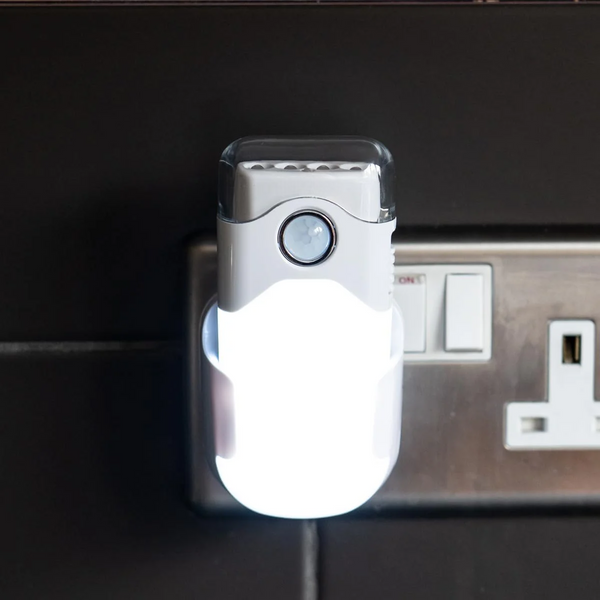
The keystone of the whole setup. A power-failure auto-on night light sits in a wall socket and does nothing while the power’s working. The second the mains drops, it switches on automatically using its built-in rechargeable battery. No fumbling, no waiting.
Plug one into a central hallway socket where most household traffic passes. If you have a two-storey home, put one on each level.
2. Two portable torches — at fixed, known locations
“Somewhere in the kitchen drawer” doesn’t count. Pick two specific spots — like the top shelf of the linen cupboard and the second drawer of the kitchen — and put a torch in each, every time. A rechargeable LED torch like our 5 inch LED Rechargeable Task Light holds charge for months and runs for up to 8 hours per charge.
3. Motion-activated lights in the hallway
If you wake up at 3am during an outage and need the toilet, you need lights that come on without you having to find a switch. A motion-sensor night light in the hallway (most plug into the wall socket with auto-on backup) bridges the gap between “asleep” and “at the bathroom.”
4. A multi-function torch or work light in the kitchen
If the outage stretches into the next morning, the kitchen is where you’ll need real working light — to make breakfast, find documents, find pet food. A multi-function light that doubles as a work light (focused beam) and a wide area light is far more useful than a phone torch held in your teeth.
5. Cabinet lights for bathrooms and pantries
A small rechargeable motion-activated cabinet light in the bathroom (medicine cabinet area) and another inside the pantry gives you task-level light in the two places you’ll most likely need it during a multi-hour outage.
Where to put each light (room by room)
- Hallway: power-failure auto-on night light in the socket nearest the centre of the house.
- Bedrooms: motion-sensor night light plugged in low to the floor (so it lights the path out of the room).
- Bathroom: cabinet light on the vanity, with motion sensor.
- Kitchen: portable torch in a known drawer, plus a power-failure night light in the wall socket above the bench.
- Stairwell: motion-sensor night light at the top of the stairs (the most critical) and another at the bottom.
- Garage / shed: rechargeable handheld torch hung in a fixed spot you can find by feel.
5 common mistakes people make
- Relying on phone torches. Your phone is at 30% before the outage even starts. Phone torch drains battery you need for emergency calls and weather updates.
- Buying disposable-battery torches. The batteries are always dead when you need them. Rechargeable, mains-charged is the only sane option.
- Putting torches “somewhere safe.” Safe means “you won’t find it in the dark.” Pick fixed, predictable spots.
- Candles. Fire risk in a dark house with kids or pets. Don’t.
- One single backup light for the whole house. If it’s in the wrong room when the power drops, you’re still in the dark.
Frequently asked questions
How long do power-failure night lights work during an outage?
Our Power Failure Night Light runs for several hours on a full charge — enough to cover most overnight outages. Longer outages (4+ hours) may require additional torch backup.
Do these actually work in real outages, or just for show?
The auto-on circuit is wired directly to the mains feed. The moment voltage drops, the internal battery takes over and the LED switches on — no user input needed. We test every product in real Australian home conditions before listing it.
What about smoke alarms and safety equipment during a blackout?
This guide covers lighting only. Smoke alarms with backup batteries, a corded landline phone, and a battery-powered radio are equally important. Don’t over-rely on lighting alone.
Are these certified for Australian electrical use?
Yes. Every Glomix product is built and certified for Australian electrical standards, uses the AU 3-pin plug, and ships from our Australian warehouse. 1-year warranty on everything.
Be ready before the next storm
The right time to set up emergency lighting is before you need it — not at 11pm when the lights cut out and the kids are crying. The whole package can be set up in under 30 minutes and costs less than dinner for two.
Browse our emergency lighting range or email us if you’d like help choosing what’s right for your home.