Smart Lights vs Motion Sensor Night Lights: Which is Right for Your Home?
Share
Walk into any lighting aisle (or scroll any lighting store) and you’ll find two very different answers to the same problem: “I want light without flicking a switch.” One is the smart light — app-controlled, voice-activated, connected to your wi-fi. The other is the humble motion sensor light — no app, no account, no hub. It just turns on when you walk past.
Both are good at different jobs. Here’s an honest comparison so you buy the right one the first time.
What each one actually is
Smart lights connect to your home wi-fi (sometimes via a hub) and are controlled from an app or a voice assistant. You can schedule them, dim them, change colours, and tie them into routines — “turn everything off at 11pm”.
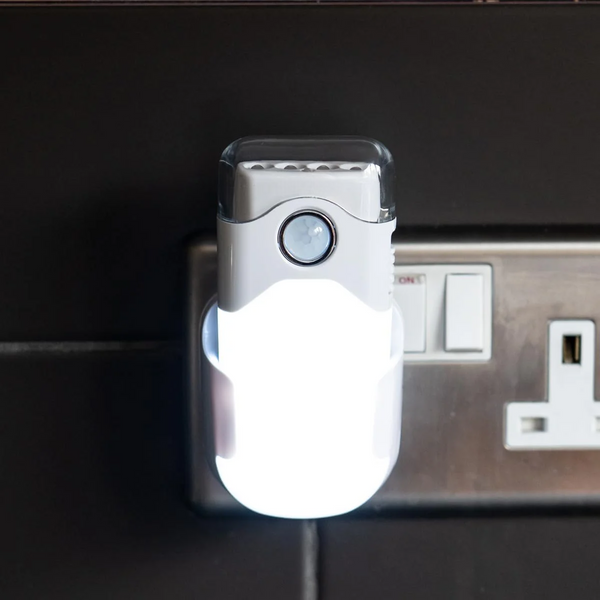
Motion sensor lights use a small infrared sensor to detect movement, usually combined with a light sensor so they only activate in the dark. No connection, no configuration — power them and they work.
The comparison that matters
Setup
Smart lights need an app, an account, a wi-fi password, and occasionally a firmware update before you see any light. Motion sensor lights need a wall socket or a charge. If the person using the light isn’t the person who set it up — an elderly parent, a rental guest, the kids — simplicity wins.
Reliability
Smart lights are only as reliable as your wi-fi and the manufacturer’s server. Motion sensor lights have nothing to drop out. A sensor light bought today works identically in five years, regardless of which apps have shut down by then.
Power outages
This is the one most people miss: a smart light connected to mains power is useless in a blackout — exactly when you need light most. A power-failure night light has a built-in rechargeable battery and switches on automatically the moment mains power drops. No smart bulb does that out of the box.
Cost
A decent smart bulb starts around $15–25 per bulb, before any hub. Whole-room smart setups run into the hundreds. A quality motion sensor night light is a one-off $20–35 and covers a hallway on its own.
Privacy & data
Smart lights are connected devices — they come with accounts, apps and data policies. A motion sensor light doesn’t know who you are. For some households that’s irrelevant; for others it’s the deciding factor.
Where smart lights genuinely win
Fairness matters: if you want colour scenes in the living room, scheduled lamps while you’re on holiday, or one voice command that dims the whole house for movie night — that’s smart lighting territory, and a sensor light won’t do it.
The quick decision guide
- Hallways, stairs, bathrooms at night → motion sensor. Hands-free is the whole point.
- Elderly parents or young kids → motion sensor. Zero learning curve, nothing to configure.
- Blackout backup → power-failure night light. Smart bulbs go dark with the grid.
- Wardrobes, pantries, cupboards → motion sensor (battery or rechargeable). No wiring where there’s no socket.
- Mood lighting, scenes, schedules, voice control → smart lights. That’s their home turf.
Plenty of Australian homes end up with both: smart bulbs in the living areas, motion sensor lights in the transit zones — hallways, stairs, and anywhere you walk half-asleep.
Our picks for the motion-sensor side
- Power Failure Motion Sensor Night Light — motion-activated night light, automatic blackout backup, and a removable torch in one wall socket. Our most popular product for a reason.
- 3-in-1 Multifunction Night Light — the bigger, brighter version, with a beam strong enough to double as a work light.
- Motion-Activated Cabinet Light — for wardrobes, pantries and under-cabinet spots where no socket exists.
Browse the full range of motion sensor night lights here.
Frequently asked questions
Do motion sensor lights work during the day?
Most quality ones (including ours) have a light sensor, so they only activate in the dark — no daytime flashing, no wasted battery.
Can I use smart lights and motion sensor lights together?
Absolutely — they solve different problems. Smart lights for the rooms you sit in; sensor lights for the paths you walk through.
Do motion sensor night lights use much power?
Very little. LED night lights sip power in standby and only run the LED when triggered. Rechargeable models typically need charging every few weeks depending on traffic.
Are these suited to Australian sockets and standards?
Every Glomix light is built and certified for Australian electrical standards, plugs into the standard AU 3-pin socket, and ships from our Australian warehouse with a 1-year warranty.
The bottom line
Buy smart lights for atmosphere. Buy motion sensor lights for the moments you don’t want to think about lighting at all — the 2am hallway, the dark pantry, the blackout. For most Australian homes, that second category is where a $20 light quietly earns its keep every single night.
Shop motion sensor night lights or email us for a recommendation for your setup.